

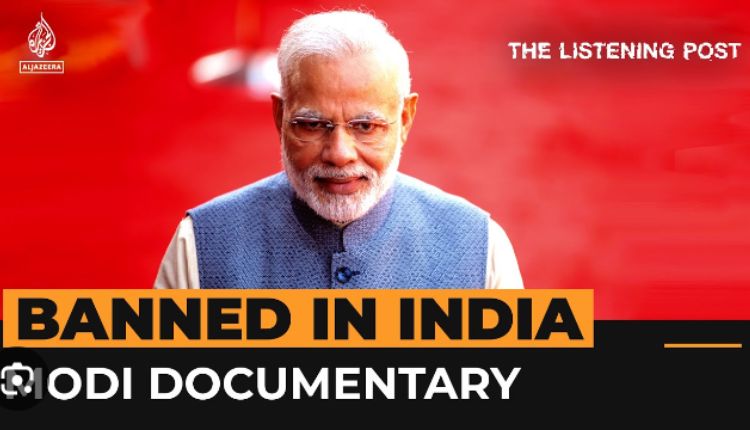
The Indian government has ordered social media platforms to block links to a two-part BBC documentary that criticises Prime Minister Narendra Modi. The government says the document reveals bias and a continuing colonial mindset.
Part One revisits allegations from two decades ago when Modi was chief minister of Gujarat and a train carrying Hindu pilgrims was set on fire. It triggered deadly riots against Muslims, leaving more than 1,000 people dead.
Narrative
The two-part bbc documentary on modi India: The Modi Question has caused a storm of controversy in the country because it alleges that Prime Minister Narendra Modi was involved in the 2002 Gujarat riots when he was chief minister of the state. It claims that the Modi government encouraged Hindu mobs to attack Muslim homes and that it refused to investigate the riots adequately. The film has prompted criticism from rightwing media outlets and social media accounts in the country. It has also whipped up a strong controversy between India and the UK at a diplomatic level.
The film is based on documents and interviews with people who survived the riots. It examines the role of Modi’s Bharatiya Janata Party (BJP), Hindutva organisations, and local leaders in the riots. It also highlights the way in which Modi’s personal and political ambitions were enabled by the riots. It is not the first time that allegations have been made against Modi’s involvement in the riots, but it is the most extensive examination to date.
Its critical portrait of Modi has triggered a backlash in the country, with Indian officials attempting to block the video from being shown in the country. They have also tried to force social media sites like Twitter and YouTube to remove clips from the film using emergency laws. They have also threatened to shut down the BBC’s local operations in India if it continued to air the documentary.
Despite these efforts, the documentary has managed to find a large audience. Many Indians have watched it online through services such as Hotstar, while others have held private screenings in their homes. Some of these have been stifled by government authorities, but others have defied orders to hold illegal screenings. One group of students from Jawaharlal Nehru University, for instance, gathered on Tuesday evening in defiance of an order by the school’s administration to watch the documentary together.
Some have even been beaten and harassed for doing so, but many continue to resist the government’s attempts to silence them. The raids on the BBC’s offices were part of a wider crackdown against independent journalism in the country.
Editing
The documentary revisits allegations that PM Modi himself and his government helped the 2002 Gujarat riots, where Muslims were harmed. It focuses on the aftermath of a fire in a train carriage carrying Hindu pilgrims, which killed 58 people and set off a wave of retaliatory violence in which hundreds of homes were burned or destroyed. The riots were led by Hindu mobs and allegedly supported by police. The film also discusses how the incident fueled religious hatred and has had a lasting impact on India.
The Indian government has condemned the documentary and blocked it from social media. It has even gone so far as to personally get Twitter to take down or obscure dozens of tweets that shared the film, and YouTube to block uploads of it, reports NDTV. It has even blocked users from accessing the Internet Archive’s copy of the film. However, some have been able to circumvent these restrictions by using virtual private networks (VPNs).
Modi has denied any involvement in the riots and a Supreme Court investigation cleared him of all charges. But the film’s release has reignited controversy, with critics accusing the BBC of bias and urging people to boycott the programme.
It has also prompted some MPs to criticise the BBC, including Conservative Bob Blackman and Labour’s Rami Ranger. The latter wrote to the BBC’s director general, asking him if staff of Pakistani origin were involved in the documentary. He argued that the documentary had a “hatchet job” on Modi and was part of a plot to destabilise the country.
The BBC has defended its reporting and said that it had been “rigorously researched”, taking into account “a wide range of voices, witnesses and experts”, including responses from members of the BJP. It has also said that it would defend itself against the charge of bias, which it denies. The BBC has already been sued by a group that says the documentary is defamatory of India and must be removed from digital platforms. The lawsuit highlights a growing concern about the state of press freedom in the world’s largest democracy.
Soundtrack
The two-part documentary delves into a dark episode of India’s PM and his relationship with the country’s Muslims. Despite a ban in India, the BBC released the film, which has angered New Delhi. The government accuses the BBC of bias and a colonial mindset.
But critics say the documentary has a valid point. It raises questions about Modi’s role in a 2002 pogrom against Muslims. While Modi denies any involvement, the documentary suggests otherwise. It’s not just a series of accusations, but a record of Modi’s leadership during a crisis that left hundreds dead and uprooted tens of thousands of people.
Several students at the Jawaharlal Nehru University were arrested after trying to hold a screening of the documentary. They gathered outside of the main campus in defiance of university authorities and watched the program on laptops and cellphones, ignoring orders to stop the screening. They were later pelted by stones and tear gas.
The documentary opens with a build-up of ominous music, and then reveals a computer screen with a big reveal: a now declassified diplomatic cable that says Modi was responsible for the violence against Muslims in Gujarat in 2002. The director, Al Jazeera’s Kailash Satyarthi, interviewed witnesses who said Modi told police to stand back and allow Hindu extremists to attack Muslims. He also interviewed former police officers who say they saw Modi at a meeting that gave these instructions.
After the documentary aired in Britain, Indian activists and government officials criticized the BBC for showing bias against Modi. But the BBC refused to rerun it or take it down, arguing that it was not biased and was a record of a serious event.
India’s minister of information and broadcasting accused the BBC of “hostile propaganda” and anti-India garbage. He called for the documentary to be blocked on YouTube and Twitter. The platforms complied with the order, which was issued under emergency government powers. But activists and human rights groups have taken steps to keep the documentary available. One of them, Sonal Moitra, posted a link on Facebook, but it was later removed.
Cast
The BBC’s India: The Modi Question has sparked a firestorm of controversy in India. The documentary focuses on accusations that Indian Prime Minister Narendra Modi and his government are prejudiced against India’s Muslim population. The series aired in the UK this month and has been widely shared on social media. It has also prompted the Indian government to block people from watching the program inside the country.
The documentary’s main allegations are based on a British Foreign Office report from 2002 that alleges that Modi was directly responsible for anti-Muslim violence in the state of Gujarat. The riots left more than 1,000 dead and an estimated 150,000 homeless. The film examines the role of Modi, his Bharatiya Janata Party, and the Hindutva organization Rashtriya Swayamsevak Sangh in the riots.
While the documentary’s claims aren’t new, it has been highly controversial in India because it revisits allegations that were previously dismissed by courts. The film has triggered attacks by local BJP politicians and caused outrage among many people. The governing party has accused the BBC of having an anti-Modi agenda and claiming that it is spreading “discredited facts”.
Indian officials have blocked the video from being watched in the country under a cluster of information technology laws. They have also sought to stop student groups from holding screenings. However, enterprising viewers have been able to circumvent the ban by using VPNs and trading flash drives. The documentary has also been available for download from sites like YouTube.
The censorship effort has prompted protests and allegations of state-sponsored repression against minorities. Human Rights Watch has warned that the Modi government has a history of using draconian laws to muzzle criticism.
The producers of the documentary say they were not trying to make an anti-Modi film. They say that the story has been reported for years, but they did not have access to the same evidence as the Foreign Office report. They are arguing that the censorship is a violation of free speech. The BBC has also been accused of shirking its duty by not presenting both sides of the story.
Conclusion
The BBC documentary on Narendra Modi presents a comprehensive examination of the Indian Prime Minister’s life and political career. It delves into his rise from a humble background to a position of immense power and influence. The documentary also explores the controversies surrounding him, leaving viewers with a nuanced understanding of Modi’s leadership.
FAQs:
- What is the main focus of the BBC documentary on Narendra Modi? The main focus of the BBC documentary on Narendra Modi is to provide an in-depth analysis of his life, political journey, and leadership style. It explores his early life, rise to power, and the impact of his policies as Prime Minister of India.
- Does the documentary cover both positive and negative aspects of Narendra Modi’s leadership? Yes, the documentary aims to present a balanced view of Narendra Modi’s leadership by examining both positive and negative aspects. It delves into his achievements, popular initiatives, as well as controversies and criticisms surrounding his governance, allowing viewers to form a comprehensive assessment of his tenure as Prime Minister.
